English

Vibrating Feeder
Model: ZSW Series · Feeding · Rock & Ore
-
Feed Size
≤1000mm
-
Capacity
60-1200t/h
-
Power
11-37KW
- ISO9001
- CE
- EAC
We reply within 24 hours
Product Overview
What Is a Vibrating Feeder?
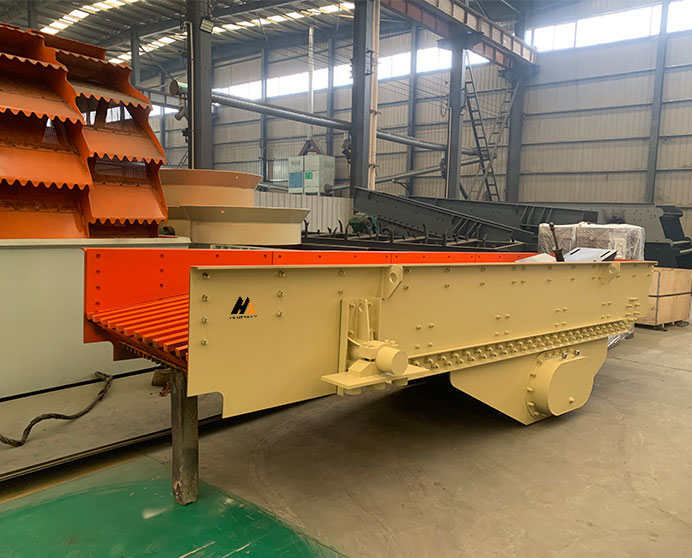
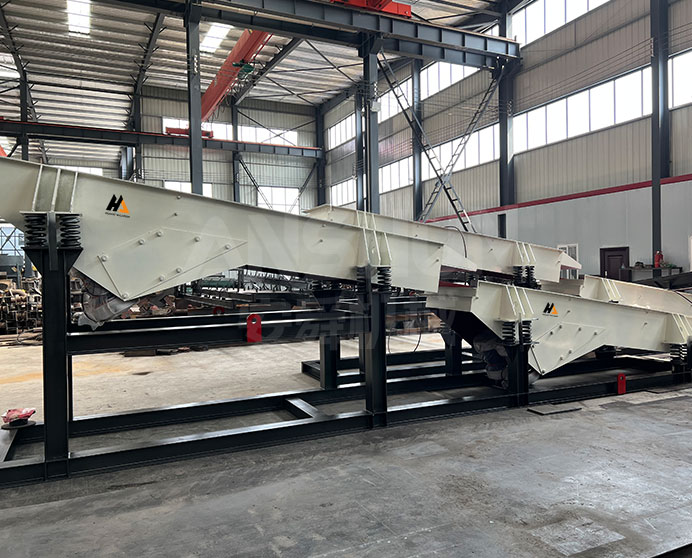
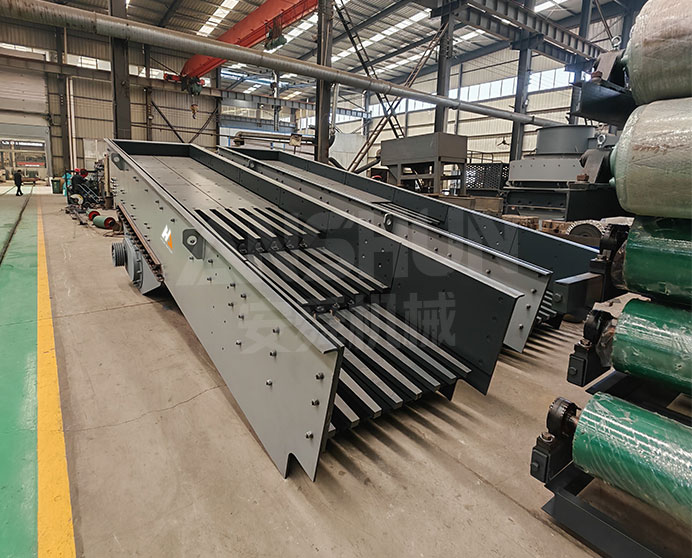
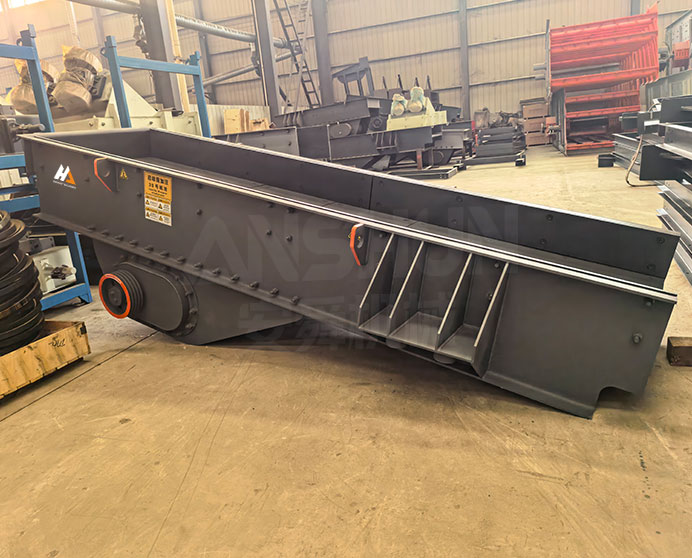
The ZSW vibrating feeder is a heavy-duty reciprocating-trough feeder designed to receive run-of-mine or run-of-quarry material from dump trucks, loaders, or stockpile reclaim systems and deliver it at a controlled, continuous rate to a primary crusher, screen, or conveyor. The trough vibrates along the feed direction under the action of a twin eccentric-shaft exciter, causing material to advance in a series of short hops rather than sliding – a motion that prevents packing, bridges, and surge-flow events that cause crusher overload and downtime.
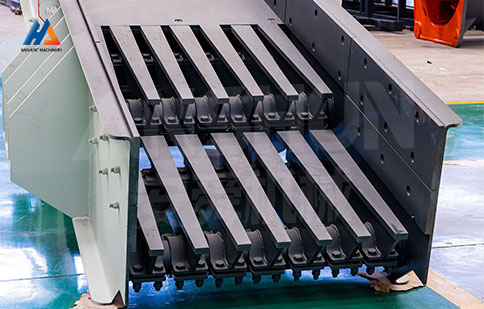
A bar grizzly at the discharge end of the trough pre-screens fines and undersized material away from the crusher feed stream, reducing crusher load and improving product gradation. Seven standard models cover funnel widths from 850 mm (ZSW850×3000, 60–100 t/h) to 1800 mm (ZSW1800×6000, 600–1200 t/h), serving small quarry primary stations through to large mine crushing plants. The ZSW is the standard primary-feed unit for jaw and impact crusher installations across hard rock quarrying, metal mining, and aggregate production.
Applicable Materials
Granite, Basalt, Limestone, Quartzite, River gravel, Iron ore, Copper ore, Coal, Slag, Construction and demolition waste, Alluvial overburden
Industries
Hard Rock Quarrying, Metal & Non-Metal Mining, Aggregate & Sand Production, Coal Preparation, Highway, Railway & Hydraulic Engineering, C&D Waste Recycling, Port & Bulk-Material Handling
Technical Specifications
|
Model |
Size of Funnel(mm) |
Processing Capacity(t/h) |
Power (kw) |
Installation Slope(°) |
Overall Dimensions(mm) |
|
ZSW850×3000 |
850×3000 |
60-100 |
11 |
0-5 |
3110×1800×1600 |
|
ZSW960×3800 |
960×3800 |
100-200 |
15 |
0-5 |
3850×1950×1630 |
|
ZSW1100×4200 |
1100×4200 |
200-300 |
15 |
0-5 |
4400×2050×1660 |
|
ZSW1100×4900 |
1100×4900 |
250-350 |
18.5 |
0-5 |
5200×2050×1700 |
|
ZSW1300×6000 |
1300×6000 |
350-800 |
22 |
0-5 |
6080×2150×1525 |
|
ZSW1500×6000 |
1500×6000 |
500-1000 |
30 |
0-5 |
6080×2350×1535 |
|
ZSW1800×6000 |
1800×6000 |
600-1200 |
37 |
0-5 |
6080×2660×1600 |
Key Features & Advantages
-
Twin-Shaft Gearbox Exciter - Synchronised Dual-Axis Drive
The ZSW uses a twin-shaft gearbox-type exciter in which two eccentric shafts are coupled by precision-cut helical gears inside a sealed housing. The gear transmission forces both shafts to rotate in strict counter-phase synchronisation at all times, ensuring the resultant linear excitation force remains consistently directional and eliminates the amplitude instability and phase drift that occur with independently-mounted dual-motor arrangements. The sealed gearbox also protects the exciter internals from dust and moisture ingress in outdoor quarry and mine environments.
-
Q245R Boiler-Grade Side Plates & Reinforcement Panels
Both side plates and all reinforcement panels are fabricated from Q245R pressure-vessel (boiler) steel rather than the Q235 mild steel used in standard-grade feeders. Q245R has a minimum yield strength of 245 MPa and significantly higher notch toughness and resistance to crack propagation than Q235. Under the sustained high-cycle fatigue loading of continuous heavy-duty feeding - particularly where dump trucks discharge directly into the hopper - this material choice prevents the progressive plate tearing and side-plate cracking that is the dominant structural failure mode on competing machines.
-
Q345 Manganese-Steel Liner Plates & Floor Plate
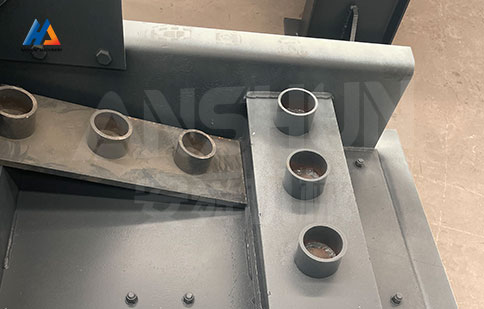
The trough floor and all internal wear-contact surfaces are lined with Q345 manganese steel plate rather than standard carbon steel. Manganese steel work-hardens progressively under repeated impact and abrasion, developing a hard surface layer while retaining a tough, crack-resistant core. The result is a liner life two to three times that of plain carbon-steel lining on hard-rock feeds such as granite and basalt, reducing the frequency and cost of liner replacement shutdowns over the machine's service life.
-
3–8° Adjustable Installation Slope - Wet and Dry Material Compatible
The ZSW is rated for installation slopes from 3° to 8° (downward toward discharge), covering both the standard dry-aggregate feed configuration and the steeper angles required for wet, sticky, or high-moisture feeds. A 3–5° slope suits dry limestone, granite, and gravel where a gentle gravity assist maintains conveying velocity without surge. A 5–8° slope is recommended for moist coal, clay-bearing ore, and water-saturated river gravel, where the steeper angle prevents material from stalling on the trough floor and building up against the feed gate. No structural alteration is required to change the slope within this range - the mounting feet incorporate slotted bolt holes for on-site angle adjustment.
What Is the Working Principle of the Vibrating Feeder?
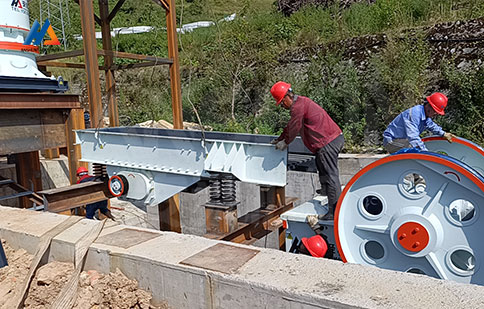
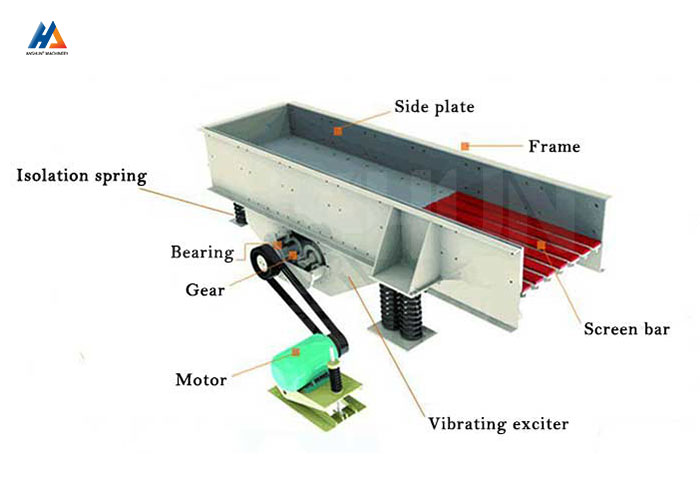
Feed material is charged into the steel funnel hopper at the feed end of the trough, either directly from dump-truck discharge or via a loader bucket. Two eccentric shafts, positioned symmetrically above the trough centre of gravity, are driven by a V-belt from the electric motor through a heavy-duty V-belt drive. The shafts carry counterweighted eccentric blocks and rotate in opposite directions at the same speed; the combined centrifugal forces resolve into a linear reciprocating force directed at approximately 30–35° to the trough floor in the forward-feed direction.
This linear vibration force causes material on the trough floor to be repeatedly lifted slightly off the surface and projected forward in micro-hops, advancing toward the discharge end at a rate proportional to vibration amplitude and frequency. Material smaller than the bar grizzly spacing falls through the grizzly bars into the undersize chute and is directed to the fine product conveyor or wash line; material retained on the grizzly bars continues to the crusher inlet. The coil spring isolators between the trough base plate and the support frame absorb residual vibration before it reaches the civil structure, preventing fatigue cracking of the hopper steelwork and foundation bolts.
Get QuoteFAQ
What is the maximum feed lump size the ZSW series can accept?
The maximum acceptable feed lump size is determined by the funnel width, not the exciter capacity. As a general rule, maximum lump size should not exceed 60–70% of the funnel width to prevent bridging at the inlet. For the ZSW850×3000 (850 mm wide) this gives a practical lump limit of approximately 500–600 mm; for the ZSW1800×6000 (1800 mm wide), up to 1100–1200 mm. For feeds containing a high proportion of material near the maximum lump size, contact us to discuss reinforced trough lining options.
Can the installation slope be set to zero for a flat-floor installation?
Yes. The ZSW series is rated for installation slopes of 0° to 5° (downward toward discharge). A 0° slope is suitable for most standard installations where the primary crusher is at grade. A slight positive slope (2–5°) increases the conveying velocity and is preferred for high-moisture, sticky feeds that resist gravity-assisted movement on a flat trough. For installations where the crusher feed opening is at a height that requires an upward slope, a belt feeder should be specified instead.
How often do the exciter bearings require lubrication?
The exciter shaft bearings are grease-lubricated via external nipples and require re-greasing every 200–300 operating hours under normal conditions – more frequently in high-dust or high-temperature environments. We recommend using a lithium-complex grease with an NLGI Grade 2–3 rating and an operating temperature range above 120°C. Full bearing replacement intervals depend on load and duty but are typically 8,000–12,000 hours in primary crushing applications.
Is On-site Commissioning Support Available?
Remote commissioning support via video call is included at no charge. On-site engineer dispatch is available as an optional paid service — lead time and cost depend on location. Please discuss before purchase.