English

Rod Mill
Model: Rod Mill Series · Grinding · Ore & Minerals
-
Feed Size
≤20mm
-
Capacity
1.6-340 t/h
-
Power
22-1000 kw
- ISO9001
- CE
- EAC
We reply within 24 hours
Product Overview
What Is a Rod Mill?
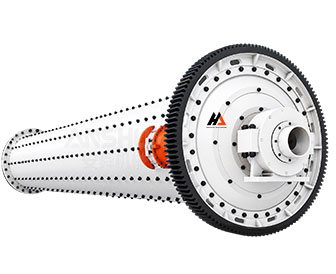
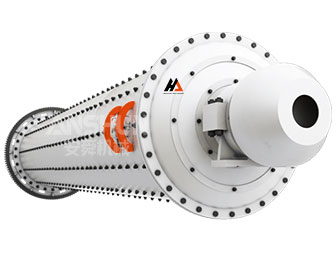
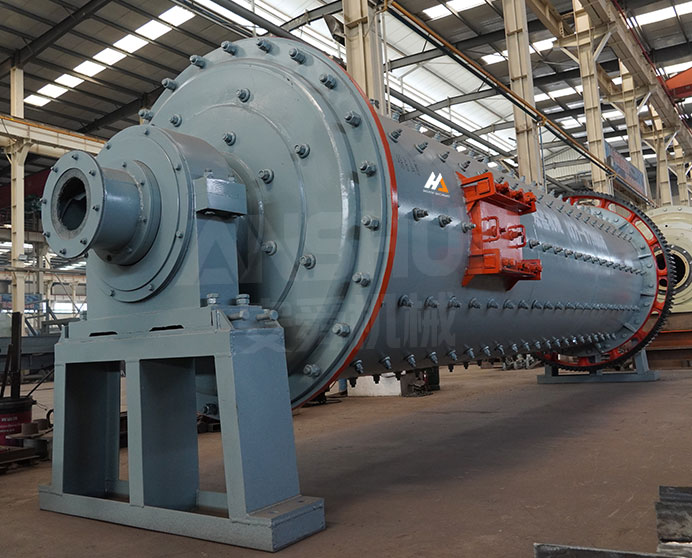
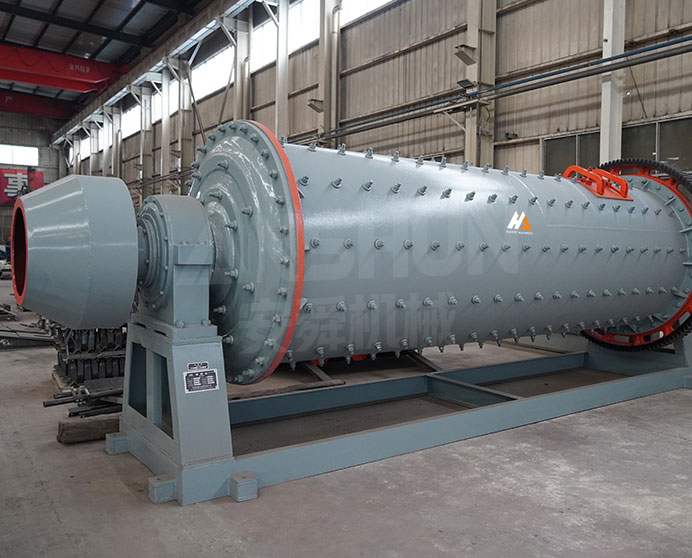
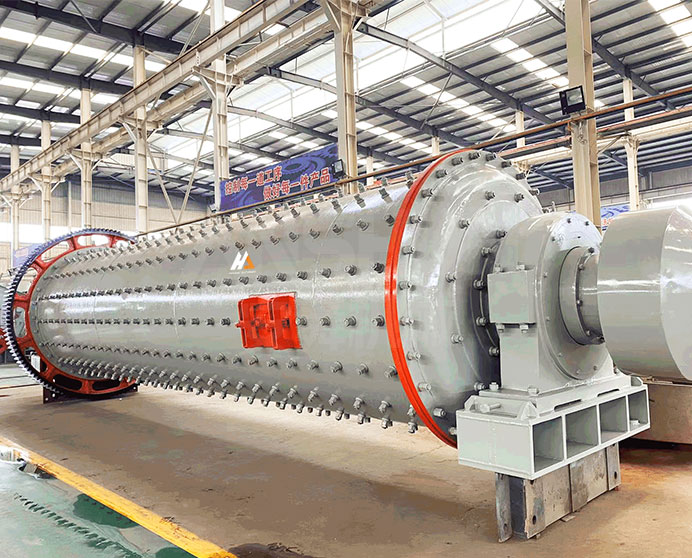
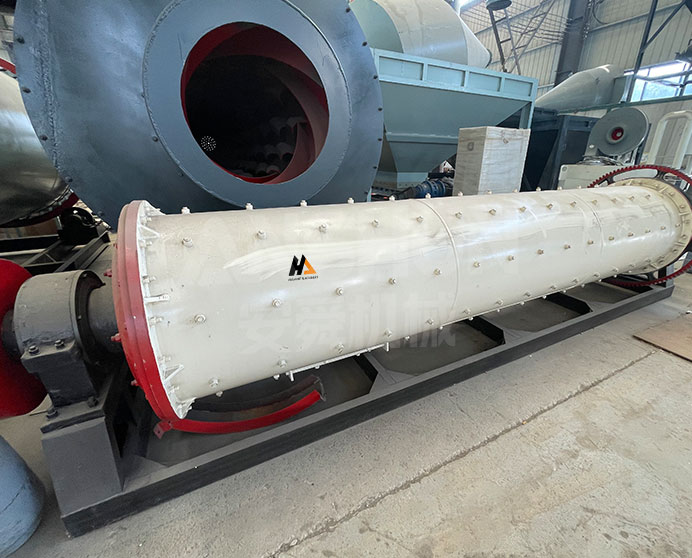
The rod mill is a horizontal rotating cylindrical mill that uses long steel rods, oriented parallel to the cylinder axis, as the grinding medium. Compared to ball mills, the rod charge contacts feed material along line contacts rather than point contacts, producing a more selective grinding action: larger particles are preferentially broken while finer material passes through with less additional reduction. This results in a narrower output particle-size distribution and reduced generation of unwanted ultra-fines – properties that make the rod mill the preferred choice for primary grinding ahead of a secondary ball mill, or for applications where overgrinding directly causes product loss, such as gravity separation of valuable minerals.
Twenty-three standard models cover cylinder diameters from φ900 mm to φ3600 mm and lengths from 1800 mm to 5400 mm, with effective grinding volumes from 0.85 m³ to 50 m³ and capacities from 1.6 t/h to 340 t/h. MBZ designations denote high-capacity variants of selected cylinder sizes, carrying a heavier rod charge and higher installed power for increased throughput within the same cylinder envelope. The rod mill is widely used in metal-ore beneficiation, particularly tungsten, tin, tantalum-niobium, and other ores processed by gravity separation, as well as in rod-ball grinding circuits ahead of flotation.
Applicable Materials
Tungsten ore, Tin ore, Tantalum-niobium ore, Iron ore, Gold ore, Copper ore, Manganese ore, Chrome ore, Quartz, Feldspar, Industrial mineral feedstock for two-stage grinding circuits
Industries
Rare & Non-Ferrous Metal Ore Beneficiation, Iron Ore Processing, Gravity Separation & Heavy Mineral Processing, Two-Stage Rod-Ball Grinding Circuits, Industrial Mineral Processing
Technical Specifications
|
Model |
Cylinder |
Effective volume(m³) |
Rod weight(t) |
Rotary speed(r/min) |
Power(kw) |
Capacity(th) |
Weight(t) |
|
MB 0918 |
φ900×1800 |
0.85 |
2.3 |
38 |
22 |
6-1.6 |
6.2 |
|
MB 0924 |
φ900×2400 |
1.15 |
3.1 |
38 |
30 |
10-2.9 |
6.6 |
|
MB 1224 |
φ1200×2400 |
2.2 |
6.5 |
32 |
55 |
13-5 |
13.5 |
|
MB 1530 |
φ1500×3000 |
5.0 |
8 |
27 |
75 |
12-5.5 |
16.71 |
|
MB 1830 |
φ1800×3000 |
6.5 |
17 |
22.8 |
132 |
20-9.5 |
29.8 |
|
MB 2122 |
φ2100×2200 |
6.7 |
18 |
20.9 |
160 |
27-12 |
42.5 |
|
MB 2130 |
φ2100×3000 |
9.2 |
25 |
20.9 |
160 |
30-13 |
43.9 |
|
MB 2136 |
φ2100×3600 |
11 |
28 |
20.9 |
200 |
35-14.8 |
49.4 |
|
MBZ 2136 |
φ2100×3600 |
11 |
32.5 |
20.9 |
210 |
61.5-43 |
49.9 |
|
MB 2140 |
φ2100×4000 |
12.2 |
31 |
20.9 |
220 |
38-17 |
50.3 |
|
MB 2145 |
φ2100×4500 |
13.8 |
35 |
20.9 |
250 |
43-19 |
51.8 |
|
MB 2430 |
φ2400×3000 |
12.2 |
31 |
19 |
250 |
47-22 |
56.0 |
|
MBZ 2430 |
φ2400×3000 |
12.2 |
31 |
19 |
250 |
73-52 |
58.3 |
|
MB 2436 |
φ2400×3600 |
14.6 |
37 |
19 |
280 |
55-26 |
61.0 |
|
MBZ 2436 |
φ2400×3600 |
14.6 |
37 |
19 |
280 |
84-60 |
62.4 |
|
MB 2730 |
φ2700×3000 |
15.3 |
35 |
17.5 |
315 |
125-37.5 |
75.6 |
|
MB 2736 |
φ2700×3600 |
18.4 |
42 |
17.5 |
355 |
150-45 |
81.8 |
|
MB 2740 |
φ2700×4000 |
20.5 |
47 |
17.5 |
400 |
165-50 |
84.3 |
|
MB 3040 |
φ3000×4000 |
25.9 |
50 |
16.2 |
500 |
206-62 |
130 |
|
MB 3245 |
φ3200×4500 |
33 |
56 |
15.5 |
630 |
228-70 |
138 |
|
MB 3248 |
φ3200×4800 |
34 |
60 |
15.5 |
710 |
240-74 |
142 |
|
MB 3645 |
φ3600×4500 |
40.8 |
78 |
14.5 |
800 |
270-83 |
168 |
|
MB 3654 |
φ3600×5400 |
50 |
94 |
14.5 |
1000 |
340-103 |
192 |
Key Features & Advantages
-
Steel Rod Grinding Media - Selective, Even Particle Reduction
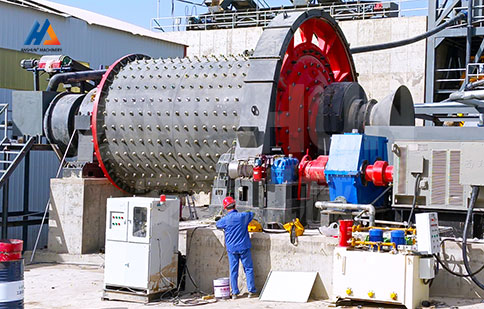
The rod mill uses long steel rods, slightly shorter than the cylinder length, as the grinding medium instead of balls. Rods run parallel to the mill axis and contact feed material along line contacts rather than point contacts, producing a more selective grinding action that reduces oversize particles preferentially while generating fewer ultra-fines than an equivalent ball mill. This makes the rod mill the preferred choice for preparing feed for downstream ball milling or for products where a narrow particle-size distribution is required.
-
Twenty-Three Standard Models, 1.6–340 t/h
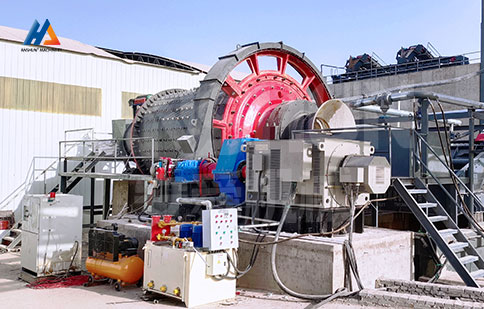
The MB/MBZ series covers cylinder diameters from φ900 mm to φ3600 mm and lengths from 1800 mm to 5400 mm, providing twenty-three combinations of effective volume (0.85–50 m³) and capacity (1.6–340 t/h). MBZ designations indicate higher-capacity variants of the same cylinder dimensions as the corresponding MB model, achieved through optimized rod charge and drive power for higher-throughput duty.
-
High-Capacity MBZ Variants
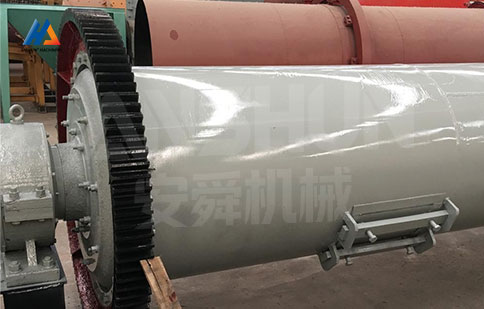
For the φ2100×3600, φ2400×3000, and φ2400×3600 cylinder sizes, both standard (MB) and high-capacity (MBZ) variants are available. The MBZ variants carry a heavier rod charge and higher installed power within the same cylinder envelope, increasing capacity by approximately 75–115% over the corresponding MB model - useful where a higher throughput is required without increasing the cylinder footprint or civil foundation size.
-
End-Peripheral or Overflow Discharge Configurations
Rod mills are configured with either overflow discharge (material exits through a discharge trunnion at the opposite end from feed, suited to wet grinding and finer products) or end-peripheral discharge (material exits through openings in the shell near the discharge end, suited to coarser grinding with reduced overgrinding). Discharge configuration is specified at order stage based on the target output size and downstream process requirements.
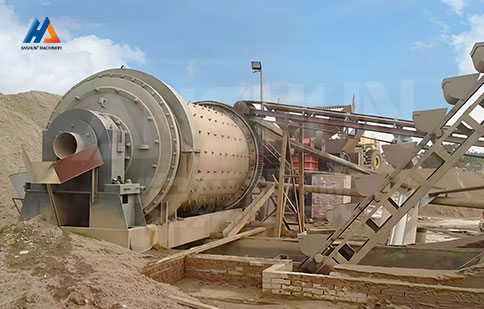
-
Robust Cylinder & Trunnion Construction for Continuous Duty
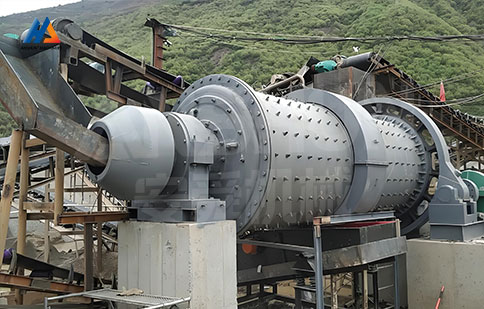
The cylinder shell and trunnion heads are fabricated from thick-section steel plate with cast or forged trunnion necks, designed for continuous 24-hour operation under the cyclic loading of the rotating rod charge. Replaceable wear liners protect the cylinder interior, and trunnion bearings are sized for the full rod-and-cylinder mass plus feed material load at the rotary speeds shown in the specification table.
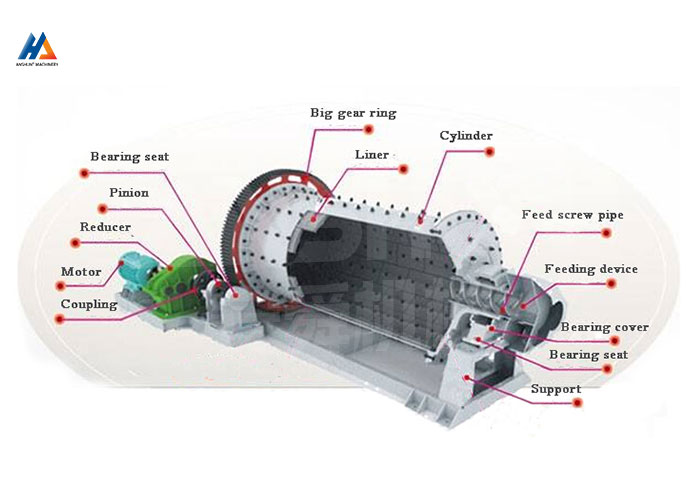
What Is the Working Principle of the Rod Mill?
Crushed feed material enters the cylinder through the feed trunnion at one end, joining the charge of long steel rods already present in the mill. The cylinder, supported on trunnion bearings, is rotated by the main drive at the rotary speed shown in the specification table. As the cylinder rotates, friction lifts the rod charge along the rising side of the shell; the rods roll and cascade down through the material bed under gravity, maintaining substantial line contact with each other and with the feed material along their full length.
This line-contact rolling and cascading action crushes larger particles caught between rods while allowing finer particles to pass through the gaps between rods with comparatively little additional grinding - the source of the rod mill's selective, narrow-distribution output. Material progressively advances along the cylinder length from the feed end toward the discharge end. In an overflow-discharge configuration, ground slurry exits over a discharge trunnion at the far end, similar to a ball mill. In an end-peripheral-discharge configuration, material exits through slotted openings around the shell circumference near the discharge end as soon as particles are small enough to pass through the slots - reducing residence time for already-sized material and limiting overgrinding.
Get QuoteFAQ
What is the difference between a rod mill and a ball mill, and when should each be used?
A rod mill uses long steel rods that contact material along line contacts, producing a selective grinding action that preferentially breaks larger particles while passing already-fine material with minimal further reduction – resulting in a narrower particle-size distribution and less overgrinding. A ball mill uses spherical media with point contacts, producing a more random grinding action suited to finer, more uniform target sizes. Rod mills are typically used for primary grinding of crushed ore (reducing from ≤25 mm down to 1–5 mm) ahead of a secondary ball mill, or where a narrow product distribution is critical (e.g., to minimize fines loss in gravity separation). Ball mills are used for secondary/tertiary grinding to flotation feed fineness (0.074–0.4 mm).
What is the difference between MB and MBZ models of the same cylinder size
MB and MBZ models sharing the same cylinder dimensions (e.g., MB 2436 and MBZ 2436) have identical shell diameter and length but differ in rod charge mass, installed motor power, and resulting capacity range. The MBZ variant carries a higher rod charge and more drive power, increasing throughput capacity by roughly 75–115% over the MB variant at the same cylinder size. Selecting MBZ over MB allows a capacity increase without changing the mill’s footprint, foundation, or building envelope – useful for plant expansions on constrained sites.
How is overflow discharge different from end-peripheral discharge, and which should I choose?
In overflow discharge, ground material and slurry exit through a trunnion at the discharge end, similar to a ball mill – this configuration is suited to wet grinding and produces a finer average product due to longer material residence time. In end-peripheral discharge, material exits through slotted openings around the shell circumference near the discharge end as soon as it is small enough to pass through the slots, reducing residence time and producing a coarser, more controlled product with less overgrinding. Choose overflow discharge when a finer grind or compatibility with downstream wet processing is the priority; choose end-peripheral discharge when minimizing fines generation is the priority, such as ahead of gravity separation.
Is On-site Commissioning Support Available?
Remote commissioning support via video call is included at no charge. On-site engineer dispatch is available as an optional paid service — lead time and cost depend on location. Please discuss before purchase.