English

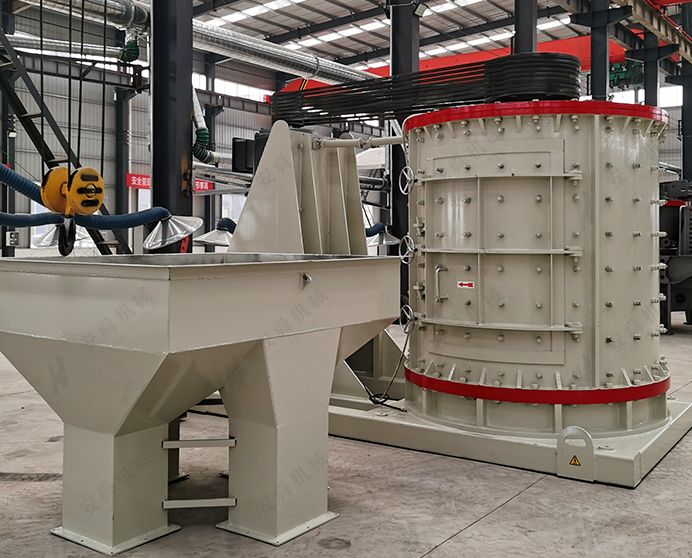
PLF Vertical Compound Crusher
Model: PLF Series · Sand Making · Soft to Medium Hard Rock
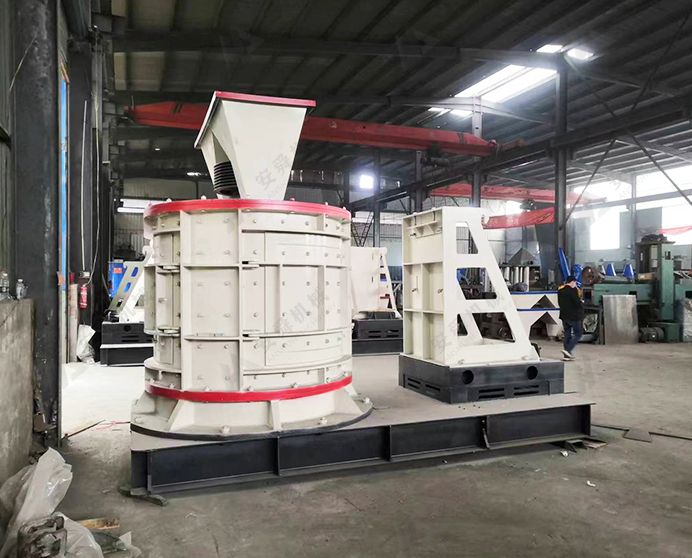
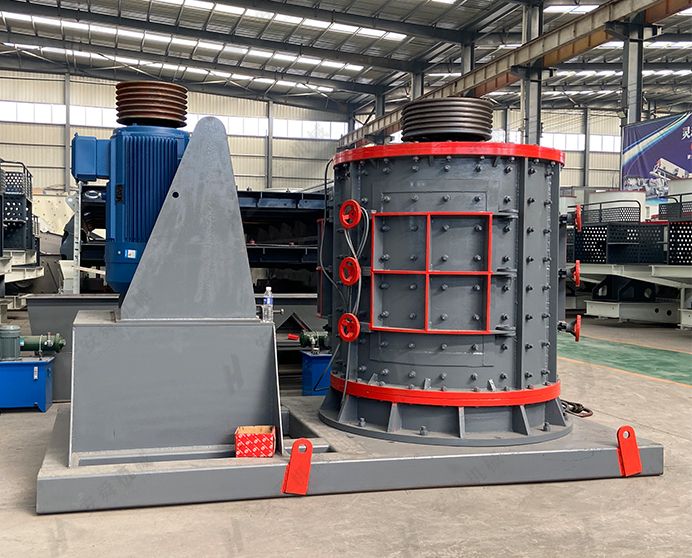
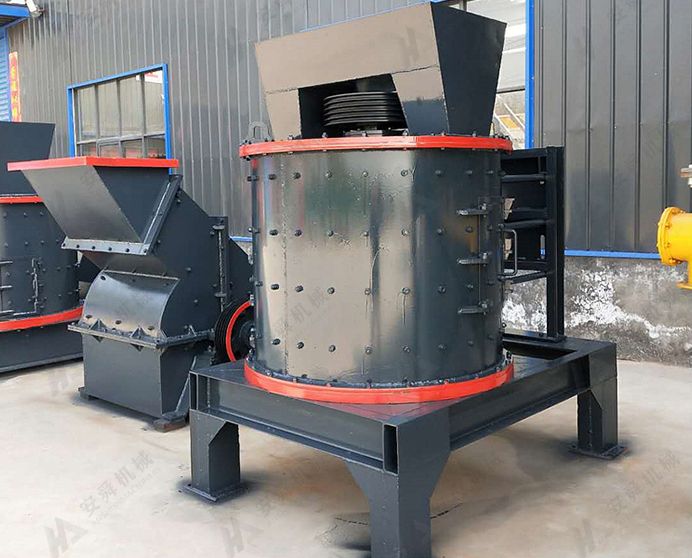
-
Capacity
10-230 t/h
-
Feed Size
≤220mm
-
Power
37-250 kw
- ISO9001
- CE
- EAC
We reply within 24 hours
Product Overview
What is a PLF Vertical Compound Crusher ?
The PLF Vertical Compound Crusher is an ultrafine crushing machine that combines hammer impact and inter-particle grinding in a single vertical-shaft rotor – producing ≥60–90% passing 3–5 mm from feed material up to 220 mm. Where conventional secondary and tertiary crushers deliver a broad size distribution that requires extensive recirculation, the PLF’s compound crushing action – impact at the rotor hammer face followed by particle-on-particle grinding in the annular chamber – concentrates the output in the sub-5 mm range in a single machine pass.
Six models from PFL-800 to PFL-2000 scale from 10 t/h up to 230 t/h. The vertical shaft layout gives the PLF a compact, small-footprint profile relative to its capacity – an advantage in retrofitting existing buildings and mobile applications. All models produce the same output specification: ≥60–90% sub-3–5 mm, with the passing percentage adjustable by changing spindle speed.
Applicable Materials
Limestone, Cement clinker, Coal, Gypsum, Calcite, Dolomite, Soft-medium brittle minerals ≤200 MPa, Chemical raw materials.
Industries
Cement Pre-Grinding, Coal Preparation, Chemical Mineral Processing, Building Materials, Limestone Powder Production, Agricultural Mineral Processing.
Designed for brittle, low-to-medium abrasiveness materials. Not recommended for hard abrasive rock (granite, quartzite, river pebble) – contact us to confirm suitability.
Technical Specifications
|
PLF Vertical Compound Crusher Technical Parameters |
||||||
|
Model |
Input Size(mm) |
Output Size(mm) |
Capacity(t/h |
Spindle Speeds(r/min) |
Power(kw) |
Overall Dimensions (mm) |
|
PFL-800 |
<100 |
<3-560-90% |
10-20 |
934 |
37 |
2100×1200×1700 |
|
PFL-1000 |
<120 |
<3-560-90% |
20-40 |
769 |
55 |
2600×1400×1900 |
|
PFL-1250 |
<150 |
<3-560-90% |
40-70 |
530 |
90 |
2800×1600×2100 |
|
PFL-1500 |
<190 |
<3-560-90% |
70-100 |
495 |
160 |
3100×1900×2200 |
|
PFL-1750 |
<200 |
<3-560-90% |
130-190 |
424 |
200 |
3710×2360×2390 |
|
PFL-2000 |
<220 |
<3-560-90% |
160-230 |
370 |
250 |
4100×2660×2620 |
Key Features & Advantages
-
Compound Crushing Action - Impact + Inter-Particle Grinding in One Machine
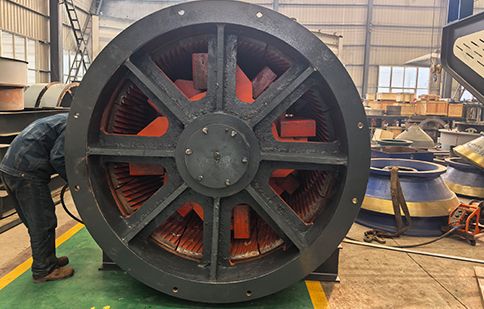
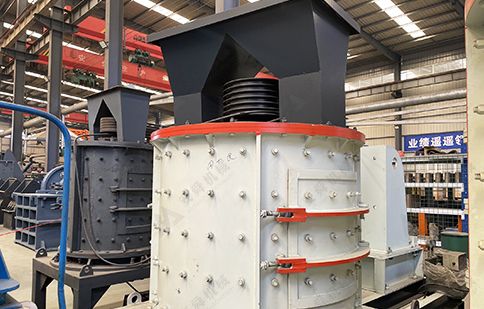
The vertical rotor delivers two distinct size-reduction mechanisms simultaneously: hammers strike feed at high velocity (impact crushing) and the resulting particles collide and grind against each other in the annular outer chamber (inter-particle attrition). This compound action produces a higher sub-5 mm fraction than either mechanism alone - the defining performance advantage of the PLF over single-mechanism fine crushers.
-
≥60–90% Sub-3–5 mm Output - Near Mill-Feed Quality in One Pass
All PLF models deliver ≥60–90% passing 3–5 mm as the design output target. For cement pre-grinding and fine mineral applications, this approaches ball mill feed specification in a single crushing pass - reducing mill energy consumption and increasing mill throughput without adding a separate fine screening and recirculation circuit.
-
Vertical Shaft Compact Layout - Small Footprint, Easy Retrofit
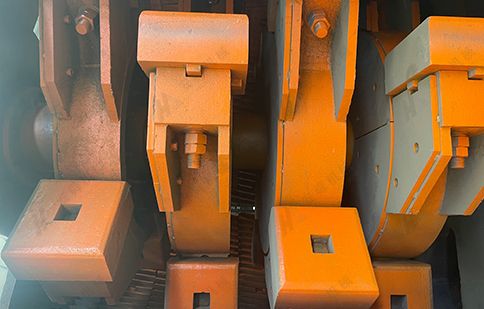
The vertical shaft rotor and compact annular chamber give the PLF a significantly smaller floor footprint than horizontal-shaft fine crushers of equivalent capacity. This makes the PLF the practical choice for retrofitting into existing buildings with limited headroom or floor area, and for mobile applications where machine envelope is constrained.
-
Spindle Speed Control - Adjustable Output Gradation
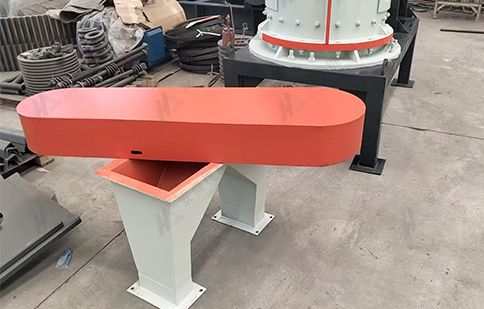
Increasing spindle speed raises hammer tip velocity, increasing impact energy and inter-particle grinding intensity - shifting the output finer and raising the sub-5 mm passing percentage. Reducing speed produces a coarser output with higher throughput. Adjusting speed is the primary tool for matching PLF output gradation to downstream process requirements without changing internal components.
-
Simple Vertical Structure - Low Maintenance Complexity
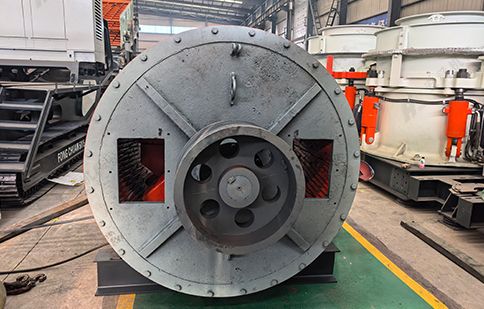
The vertical shaft design minimises the number of moving components and eliminates the counterweight and frame complexity of horizontal-shaft crushers. Hammer replacement is performed through the top access door without removing the rotor - a straightforward task for any maintenance technician, reducing planned maintenance duration and required skill level.
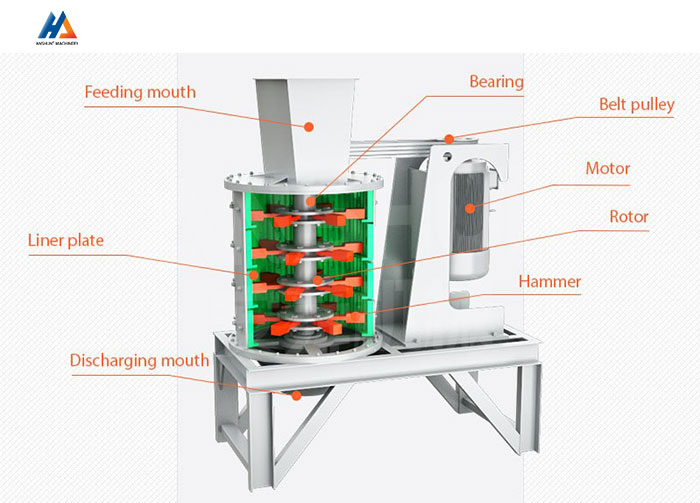
What Is the Working Principle Of the PLF Vertical Compound Crusher
Feed material enters the crushing chamber from the top inlet and falls onto the high-speed vertical rotor. Hammer elements on the rotor strike incoming material at high velocity, fracturing it through impact and projecting the broken particles outward at high speed. The particles then enter the annular outer chamber, where they collide with the chamber liner and with each other - the inter-particle grinding phase that further reduces particle size and improves the sub-5 mm fraction beyond what impact alone achieves.
Crushed material exits from the bottom of the annular chamber onto the discharge conveyor. Product fineness is controlled by the spindle speed: at maximum speed, tip velocity is highest, impact energy is greatest, and the sub-5 mm passing percentage reaches its maximum (≥90% on the design specification). Reducing speed to the lower end of the range reduces energy intensity, shifts output coarser, and increases throughput at the cost of a lower passing percentage (≥60%).
Get Quote
FAQ
How Does the PLF Compound Crusher Differ from a Standard Vsi Sand Maker?
VSI sand makers use high-speed impact in an open rotor design and are optimised for cubical particle shape and broad capacity range on hard, abrasive feed. The PLF adds inter-particle grinding in a closed annular chamber to concentrate the output in the sub-5 mm range – producing a higher passing percentage at the same throughput on soft-to-medium brittle materials. For hard abrasive feed (granite, river pebble), the VSI is the correct tool; for cement clinker, coal, and soft limestone, the PLF’s compound action delivers a finer product at lower wear cost.
What is the Practical Sub-5 mm Passing Range I Can Expect on My Material?
On brittle low-abrasion materials (gypsum, soft limestone, coal), the passing percentage reaches the upper end of the 60–90% range at maximum spindle speed. On harder or more irregular feed (denser limestone, clinker with high alkali content), the passing percentage tends toward the lower end of the range. We recommend providing a representative material sample for test crushing before finalising the model selection for a critical application.
Can Hammers be Replaced Without Removing the Rotor?
Yes – the top access door provides clear access to the hammer mounting positions. Individual hammers can be removed and replaced with standard tools without lifting the rotor out of the machine. A full hammer set change typically takes 2–3 hours for a two-person maintenance team. Hammers are symmetric and can be rotated 180° before replacement to equalise wear and double effective service life.
Is the PLF Suitable for Continuous 24-hour Operation?
Yes – all PLF models are designed for continuous duty. Bearing temperature and vibration should be monitored during the first 200 hours of operation to establish baseline values, and lubrication intervals followed as specified in the maintenance manual. Planned hammer inspection and rotation at 300-hour intervals is recommended for continuous operation on abrasive feed materials.
Is On-site Commissioning Support Available?
Remote commissioning support via video call is included at no charge. On-site engineer dispatch is available as an optional paid service — lead time and cost depend on location. Please discuss before purchase.